


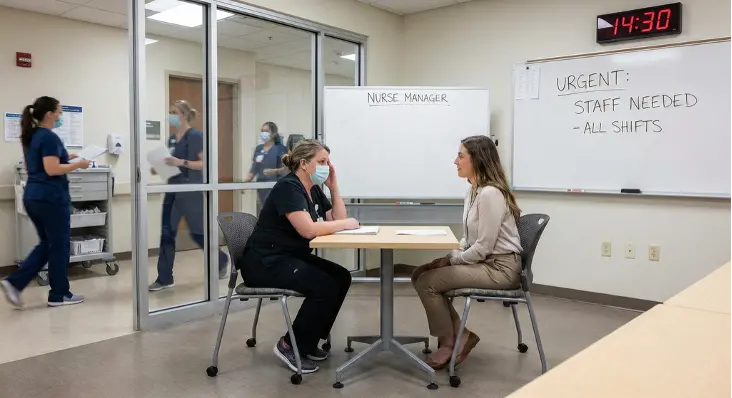
Hospitals across the USA are facing registered nurse shortages. This is due to patient demand growing faster than the available nurse workforce, resulting in a clear shortage of staff at the facility.
These unfilled roles may increase pressure on the current staff, affect patient care delivery, and decrease patient satisfaction. These workforce issues can be resolved with planned staffing strategies.
Figure out the main cause of shortages
Before seeking solutions to the nurse workforce shortage, as a healthcare owner, you must first understand the problems.
Many facilities try to address registered nurse shortages without examining the reasons behind them. This may not solve your workforce issues permanently.
One typical thing you can notice is your HR teams saying there are a few candidates available for the nurse role in the market. This is the most superficial explanation and may not solve anything.
To make staffing easy, especially if you plan to hire registered nurses, you need to know about the multiple reasons from day one that may lead to burnout. To address this, a list of reasons driving shortages is provided.
Top reasons driving registered nurse staffing shortages
- Burnout because of unplanned and long shifts, and a lack of flexibility
- Retirements outpace the entry of new nurses into the sector
- Workforce planning misalignment with patient needs
Overall, the nurse staffing crisis impacts the entire hospital. Facilities that understand these reasons early will typically recover faster. The following are the top five strategies.
Strategy #1: Avoid traditional staffing agencies
To understand the problems with traditional agencies, you can assume a hypothetical case as a recruiter.
Imagine a mid-size facility has an immediate need to fill registered nurse openings.
During the process of registered nurse staffing, recruiters like you would reach out to different traditional agencies. Out of those, two agencies may provide candidate CVs that are not aligned with the roles.
The other agency provides candidates who lack experience and consistency, and may leave the position before the end of probation.
The facility has now lost its valuable time and money. This also lowers patient satisfaction. This is exactly what the traditional workforce shortage paradox may look like.
Most traditional agencies may attempt to fill the gap as quickly as possible with a candidate who might fit the role.
However, there is a different perspective in these models. In these recruiting models, recruiting and retention are separated, creating a widening gap over time.
In the remaining gaps, hospitals fill nurse positions with available candidates. This will lead to the same unaligned roles being filled again. This is known as the replacement cycle.
To address on time nurse staffing shortage solutions, hospitals need to integrate modern forms of recruitment and retention in their facility.
Strategy # 2: Practice planned staffing methods
Most facilities in the USA that depend on a last-minute-to-hire model experience the greatest strain.
Healthcare recruitment and retention of registered nurses must be based on workload alignment, not headcount. You can follow the points addressed to plan staffing.
- Prioritize operational support through flexible roles and cross-team training.
- Apply policies to control burnout and professional void, operational support.
- Facilities need to improve shift planning and predictable scheduling.
Recruiters like you can use planned solutions from a modern staffing platform to overcome registered nurse shortages, such as contracting and helping facilities plan for growth.
You can also stay prepared for seasonal or unexpected staffing surges.
Strategy #3: Draft a detailed job description while you hire
Draft a detailed job description during the staffing process.As a recruiter, you must outline job responsibilities and required certifications.
A precise description will attract qualified registered nurses to your facility. It also reduces mismatches in hiring and improves overall staffing efficiency.
Strategy #4 Maintain competitive pay strature
Facilities must understand that offering competitive pay is the main strategy for building long-term loyalty. Fair compensation from you shows that you value the expertise and dedication of your registered nurses.
When registered nurses feel their salary from you matches their skills and work, they are more likely to commit to your facility.
Competitive salaries reduce costly turnover. They also ensure that experienced registered nurses remain at the bedside to provide quality care.
Strategy #5: Retention is a better option to solve issues
Experienced recruiters like you must understand that registered nurse shortages cannot be addressed by recruiting new professionals when facilities overlook retention policies.
Most facilities like yours experience attrition within the first year, particularly among nursing roles.
Registered nurses resign due to low pay. They also leave because of vague job expectations or rigid schedules. So to overcome, you can follow the given.
Key nurse retention strategies that solve the staffing crisis
- Clearly mentioning the role responsibilities in the job description
- Establishing reasonable workload expectations and providing the associated guidelines
- Encouraging communication from senior leadership
When retention improves at facilities, the impact of the registered nurse staffing crisis will get less severe. This leads to improved overall workforce stability.
Choose the right platform to overcome staffing challenges
Healthcare facilities must understand the right strategies to solve staffing challenges. Strong planning alone is not enough. Leaders must also know where to hire registered nurses and how to avoid common recruitment obstacles that delay placements.
Relying on traditional agencies often leads to high markups, limited transparency, and slow turnaround times. Free job portals may generate high application volume, but they rarely deliver pre-vetted registered nursing professionals. Practicing these recruiting methods often extends vacancy periods.
To overcome this, facilities need to consider partnering with modern staffing platforms such as MedSquirrels.This modern platform helps facilities overcome barriers.
MedSquirrels delivers curated, AI-matched profiles of qualified registered nurses, physicians, and allied health professionals within 2–5 business days.
The platform also offers three cost-effective plans without agency markups, ensuring faster, cost-effective, and efficient healthcare staffing.