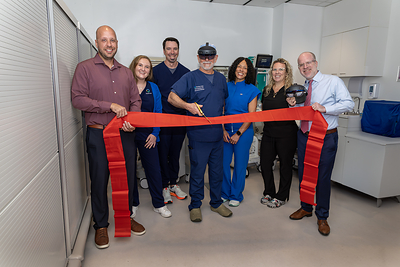
MediView XR, Inc.®, a pioneer in extended reality (XR) surgical navigation and spatial computing, today announced the successful first intraprocedural use of its flagship platform, the XR90 holographic surgical navigation system, at Cleveland Clinic Weston Hospital in Weston, Florida. The milestone procedure, a percutaneous liver mass biopsy, marks the debut clinical case for the XR90 system at the facility and establishes Cleveland Clinic Weston Hospital as the first hospital in the state of Florida to acquire and deploy this next-generation technology.
The procedure was performed by interventional radiologist Dr. Kevin Stadtlander on a female patient with a difficult-to-access liver lesion.
During the procedure, Dr. Stadtlander successfully targeted a liver lesion approximately 10 cm deep, located between two branches of the hepatic vein using the XR90 system. By fusing preoperative CT images with real-time ultrasound into a three-dimensional digital view, the physician has “x-ray vision,” seeing the patient’s anatomy directly through the skin. The visualization is aligned with the patient’s actual anatomy and projected into the patient’s body, enabling precise localization of the target and tool during the procedure. The real-time 3D image fusion provided intuitive visualization and confidence beyond what either imaging modality could provide alone, helping confirm the lesion under live ultrasound and accurately guiding needle placement to the intended target.
“This new imaging modality and intuitive visualization can be a game changer because we’re creating a holographic three-dimensional image that’s actually overlaid into the patient,” said Dr. Stadtlander. “As we perform this procedure, we’re seeing into the patient’s body three-dimensionally without any X-rays. In essence, we have ‘X-ray vision,’ but there’s no radiation involved.
“Interventional radiologists, as a group, are always at the forefront of technology and image-guided procedures. I’m very happy to take it one step further and get this new technology here at Cleveland Clinic Weston Hospital.”
Merging Modalities to Reach Peak Operator Performance
Exploring the Impact of MediView XR on Surgical Precision
Traditionally, physicians must perform percutaneous procedures by mentally reconciling individual 2D CT and ultrasound images displayed on different flat monitors positioned around the procedure room—a cognitively and ergonomically demanding task that can introduce targeting variability, especially with lesions that are anatomically challenging or difficult to localize under one imaging modality alone.
XR90 is designed to remove that burden. By projecting a fused 3D CT/ultrasound dataset directly into the operator’s field of view using a see-through XR headset, the system is intended to help physicians reach what Dr. Stadtlander describes as “peak physician performance” during needle guidance and targeting. Rather than constantly looking away from the patient to interpret separate screens, the physician can visualize the 3D spatial relationships between the anatomy, the target, and the needle trajectory in the procedural field in real time as an adjunct to standard of care.
“This case represents exactly what we set out to build,” said MediView CEO and President, Mina Fahim. “Fusing CT and ultrasound into a single 3D augmented reality view, in real time, at the point of care, gives physicians a fundamentally different way to approach procedures and opens access to less painful care. We’re proud that Cleveland Clinic Weston Hospital chose to be the first institution in Florida to bring this new capability to their patients, further expanding MediView’s relationship with Cleveland Clinic.”
A Radiation-Free Procedure Day, Designed for the Operator
While traditional needle-based interventions may require repeated intraprocedural CT scans to guide and confirm placement, the XR90 platform is designed to support a radiation-free environment on the day of the procedure. Because the pre-operative CT dataset is compiled into a comprehensive patient-specific 3D image and fused with live ultrasound, the system may potentially reduce ionizing radiation exposure for both the patient and the clinical team, while also enhancing the anatomical detail that CT provides.
The system’s ergonomic capabilities are also a focal point of the case. By consolidating multiple imaging modalities into an integrated XR headset display, the physician is not required to repeatedly look away from the patient and shift attention to external monitors positioned throughout the room. This design allows the physician to maintain visualization in line of sight with the patient and is intended to reduce physical strain and visual task switching for physicians, particularly during longer or more technically demanding procedures.
A First for Florida, and a Broader Signal for Clinical Innovation
Cleveland Clinic Weston Hospital’s acquisition of the XR90 makes it the first facility in Florida to bring this 3D XR-guided navigation capability into clinical use, positioning the hospital among a distinguished group of institutions nationwide exploring how extended reality and spatial computing can be integrated directly into interventional and image-guided procedures.
This case is emblematic of a larger shift underway in healthcare delivery. As imaging, computing, and wearable display technologies converge, hospitals are increasingly looking to implement tools that:
- Reduce reliance on ionizing radiation during procedure-day workflows.
- Fuse multiple imaging modalities in real time, rather than asking physicians to mentally combine separate, static, or sequentially acquired images.
- Improve physician ergonomics and cognitive load, keeping the operator’s attention on the patient rather than distributed across a room full of monitors.
- Extend advanced navigation capability to more complex or previously higher-risk cases, potentially widening the population of patients who are candidates for minimally invasive, image-guided approaches.
For health systems, technologies like XR90 point toward a future in which extended reality is not a novelty layered on top of existing imaging infrastructure, but a core interface through which physicians interact with patient anatomy — a future standard of care that can shorten procedure times, support more consistent outcomes across operators of varying experience levels and reduce cumulative radiation burden for both patients and care teams over time.