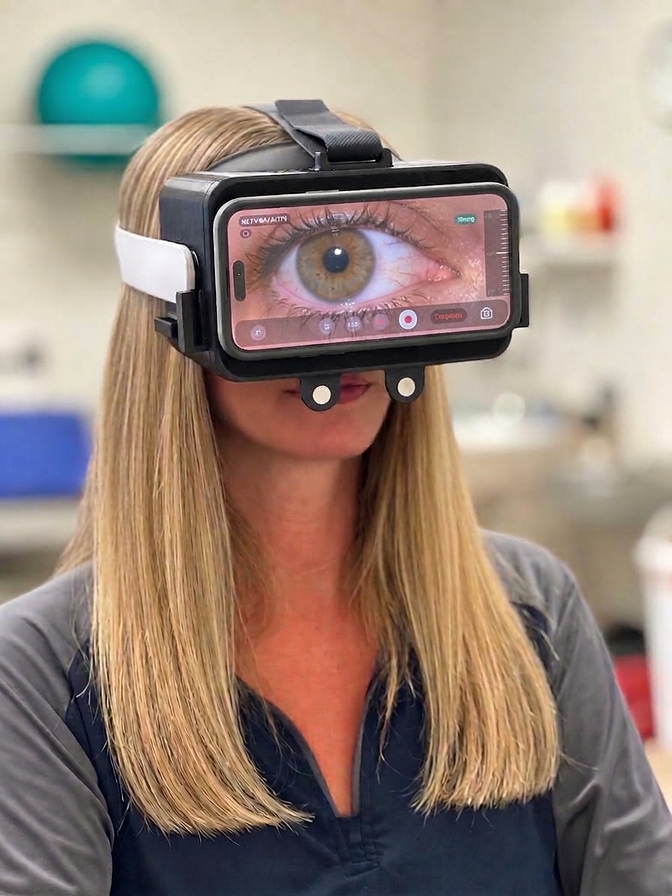
VertigoDx, a medical device innovator, today announced that it has received 510(k) clearance (K260566) from the U.S. Food and Drug Administration (FDA) for its SmartVertigo® Vestibular Assessment System, a prescription point-of-care platform designed to simplify the evaluation of vertigo, including Benign Paroxysmal Positional Vertigo (BPPV). SmartVertigo® combines a smartphone, proprietary light-occluding headset, and custom software to capture high-resolution, full-color video of horizontal, vertical, and torsional nystagmus during standard positional testing.
“BPPV is one of the most treatable causes of dizziness. The challenge has always been capturing the eye movement without complex equipment — and understanding what that movement is telling you,” said Dr. Paul Louis, CEO and Co-Founder of VertigoDx. “SmartVertigo® does both.”
Vertigo can be challenging to evaluate in acute and outpatient settings. BPPV is caused by tiny calcium crystals that dislodge within the semicircular canals, triggering nystagmus—involuntary eye movements—that clinicians must capture to make an objective diagnosis. Traditional infrared video-oculography (VOG) systems are often expensive, complex and tethered to dedicated workstations, leaving many clinicians without portable, objective diagnostic tools—resulting in care delays, unnecessary imaging, and avoidable specialist referrals.
Understanding VertigoDx and Its Impact on Patient Care
SmartVertigo® eliminates these barriers by replacing bulky infrared systems with a portable, cable-free unit. Unlike traditional infrared VOG, which produces black-and-white video, SmartVertigo® captures full-color eye movement video. Color may reveal subtle findings—vessel movement—that infrared video cannot show. Clinicians can replay video in real time, slow motion, or frame-by-frame to confirm findings.
SmartVertigo® streamlines the clinical workflow into three phases:
- Capture: Records high-resolution, full-color video of horizontal, vertical, and torsional nystagmus during standard positional testing.
- Classify: AI-assisted software, developed in collaboration with Florida Atlantic University (FAU), analyzes eye movements and suggests the likely affected semicircular canal for clinician consideration.
- Treat: Guided algorithms present targeted repositioning maneuver options with all clinical decisions remaining under physician control.
SmartVertigo® was co-invented by brothers Trevor Meyerowitz, PT and CMO of VertigoDx, and Stephen Meyerowitz, CTO of VertigoDx. Trevor has used the system with more than 1,200 patients over three years, while Stephen developed the underlying iOS application, a dedicated patient portal, and AI-assisted clinical analysis.
“I built SmartVertigo® because I was tired of treating what I thought I saw,” said Trevor Meyerowitz, PT and CMO of VertigoDx. “Some eye movements are too subtle to catch with standard Frenzel goggles. Now I can replay the video and capture the nystagmus data I need. Using AI and the SmartVertigo® algorithms gives me greater diagnostic confidence — and showing patients their nystagmus means we both know what we’re treating.”