1. Introduction
For decades, the dietary supplement industry focused mainly on ingredients such as vitamins, antioxidants, herbal extracts, and isolated bioactive compounds. Most products were designed around composition and dosage. In contrast, researchers paid much less attention to biological timing, transport specificity, and circadian regulation of metabolism.
Recent advances in circadian biology and metabolic physiology are changing this view. Researchers now show that nutrient utilization changes throughout the day together with oscillations in hormonal signaling, mitochondrial activity, glucose metabolism, digestion, and cellular recovery. At the same time, studies of peptide transport and amino acid metabolism increased interest in short peptides and essential amino acids as specialized nutritional substrates.
Within this emerging field, CAN™ developed by DiogeneAge the first commercially developed peptide-based nutritional systems organized around circadian metabolic phases. Instead of using a static supplementation model, the platform combines short peptides, essential amino acids, transport specificity, and time-structured administration into coordinated morning, daytime, and nighttime formulations designed to match predictable physiological transitions across the 24-hour cycle.
- Why Peptides Matter
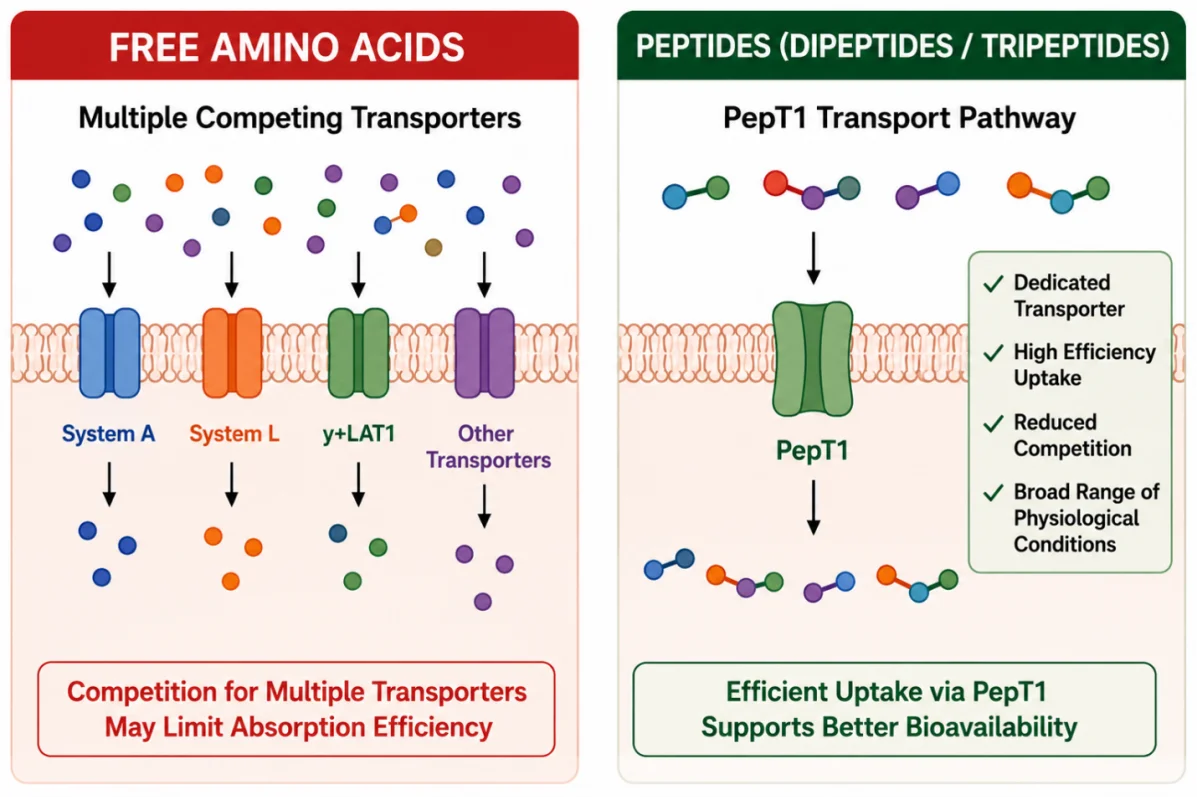
Short peptides, especially dipeptides and tripeptides, are attracting increasing attention in nutritional science because they behave differently from free amino acids. Free amino acids often compete for multiple shared transport systems. In contrast, small peptides are absorbed mainly through PepT1, a highly efficient intestinal transporter specialized for peptide-bound substrates (Daniel, 2004).
This distinction may have important physiological consequences. PepT1-mediated transport allows rapid uptake of peptide-bound nutrients across a broad range of digestive conditions while reducing direct competition with free amino acid transport pathways. As a result, short peptides may provide more efficient nutrient delivery during periods of increased metabolic demand or recovery.
Figure 1. Peptide vs Free Amino Acid Transport
In addition to serving as nutrient carriers, peptides may also participate in metabolic signaling, mitochondrial regulation, recovery physiology, and cellular adaptation. Researchers are now exploring these functions in sports nutrition, recovery science, and longevity-oriented metabolic optimization.
Recent publications by Katherine Klyushnichenko and DiogeneAge In addition to serving as nutrient carriers, peptides may also participate in metabolic signaling, mitochondrial regulation, recovery physiology, and cellular adaptation. Researchers are now exploring these functions in sports nutrition, recovery science, and longevity-oriented metabolic optimization.
Within this framework, peptides are viewed not simply as alternative protein sources, but as transport-efficient substrates that may support coordinated nutrition across different metabolic phases of the day.
- Essential Amino Acids and Metabolic Support
Essential amino acids (EAAs) remain central to human metabolism because their functions extend far beyond protein synthesis alone. Since the body cannot produce these amino acids in sufficient amounts, regular dietary intake is required to maintain metabolic homeostasis, tissue maintenance, and recovery physiology.
In addition to supporting protein synthesis, essential amino acids contribute to mitochondrial function, intermediary metabolism, neurotransmitter production, and tissue repair. Researchers increasingly discuss EAAs in recovery physiology and performance nutrition because they support tissue maintenance, metabolic adaptation, and substrate availability during physiological stress (Jäger et al., 2017).
Several amino acids also serve as precursors for signaling molecules involved in cognitive regulation, autonomic balance, and neurophysiological adaptation. Others participate directly in pathways controlling energy production, nitrogen balance, and metabolic resilience during stress and recovery.
Within circadian-aligned nutrition, timing may influence how efficiently the body uses these substrates during different metabolic phases. Morning metabolic activation, daytime nutrient processing, and nighttime recovery each create distinct energetic and biochemical demands. Coordinating amino acid delivery with these physiological states may therefore improve substrate utilization and recovery support.
Rather than focusing on maximal stimulation or high-dose performance formulas, newer nutritional approaches increasingly emphasize long-term physiological maintenance, metabolic flexibility, and coordinated recovery support. This systems-oriented perspective aligns naturally with approaches that integrate amino acids, peptides, and circadian organization into structured nutritional programs.
- Why Timing Changes the Equation
Human metabolism does not operate at a constant level throughout the day. Hormonal signaling, mitochondrial activity, glucose utilization, digestion, autonomic balance, and cellular repair all fluctuate according to circadian rhythms coordinated across the 24-hour cycle. Emerging evidence suggests that circadian alignment and feeding timing may influence metabolic resilience, recovery physiology, and healthy aging (Manoogian & Panda, 2017).
These oscillations create distinct physiological phases associated with activation, nutrient processing, and recovery.
During the morning, cortisol secretion and sympathetic activity increase rapidly as the body transitions from overnight fasting toward daytime metabolism. This phase is associated with increased mitochondrial readiness, glucose mobilization, circulatory activation, and cognitive alertness. Nutritional support during this period may therefore favor substrates involved in metabolic activation and energy utilization.
During the daytime phase, nutrient processing and metabolic responsiveness become more efficient. Insulin sensitivity, digestive activity, and substrate utilization generally improve during this period, supporting coordinated handling of amino acids, peptides, carbohydrates, and other nutrients. This phase therefore represents the main window for nutrient assimilation and metabolic regulation.
The daytime phase is characterized by active nutrient processing and greater metabolic responsiveness. Insulin sensitivity, digestive function, and substrate utilization are generally more efficient during this period, supporting coordinated handling of amino acids, peptides, carbohydrates, and other nutrients. This phase represents the primary window for nutrient assimilation and metabolic regulation.
Figure 2. Static Supplementation vs Circadian-Aligned Nutrition
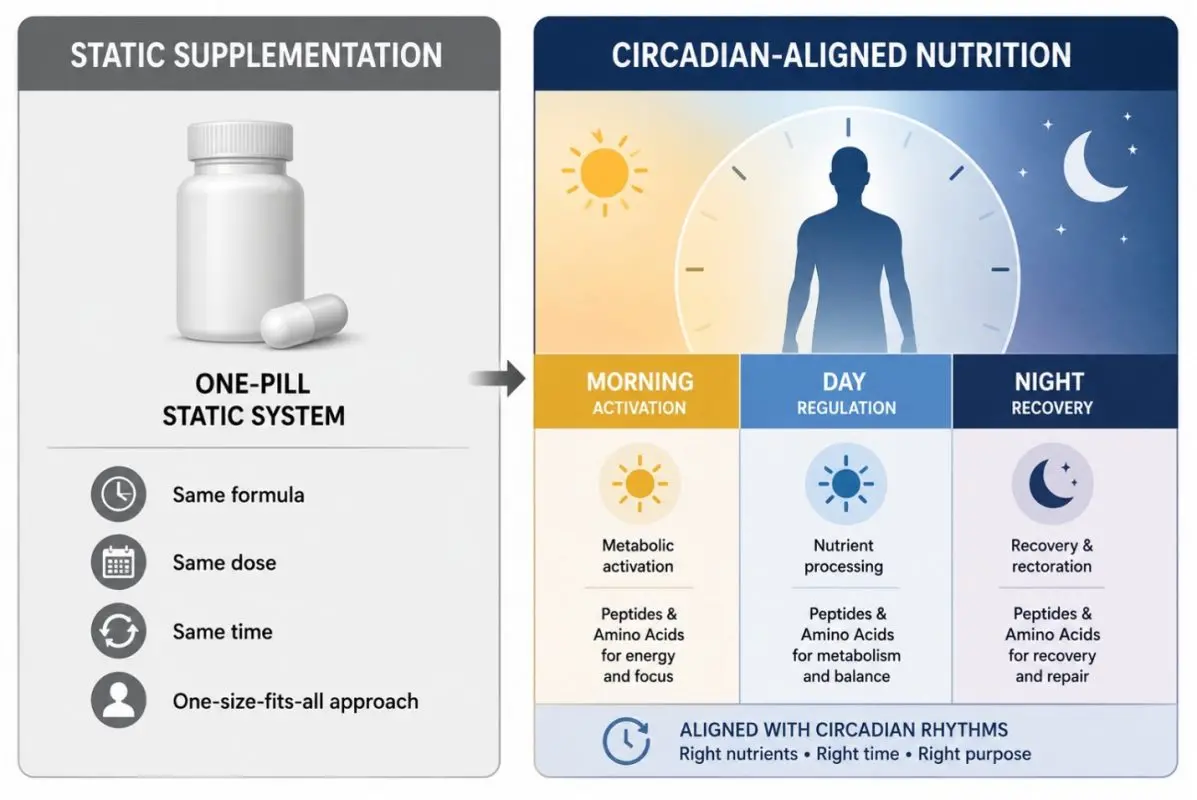
Nighttime physiology differs substantially from daytime metabolism. As melatonin levels rise and sympathetic activity declines, the body shifts toward parasympathetic predominance, recovery physiology, neurotransmitter balance, and cellular maintenance. Nutritional strategies organized around nighttime recovery may therefore prioritize restoration rather than stimulation.
Recent publications by Katherine Klyushnichenko and DiogeneAge proposed that nutrient timing may influence utilization efficiency alongside nutrient composition itself [KK Article 2]. Within this framework, circadian-aligned nutritional systems such as CAN™ attempt to organize peptide and amino acid delivery around predictable metabolic transitions throughout the day rather than relying on static supplementation models.
This systems-oriented approach reflects a broader transition from viewing nutrition as a uniform biochemical input toward understanding it as a dynamic interaction with circadian physiology.
- Why Biohackers and Longevity Communities Are Interested
Interest in circadian-aligned nutrition has grown rapidly within longevity, recovery, and performance-oriented communities. During the past decade, many individuals interested in metabolic optimization moved beyond conventional supplementation strategies centered mainly on isolated ingredients and high-dose formulations. Instead, attention increasingly shifted toward systems-level approaches integrating sleep quality, circadian alignment, recovery physiology, and metabolic resilience.
The widespread adoption of wearable technologies accelerated this shift. Devices that monitor sleep architecture, heart rate variability (HRV), glucose dynamics, recovery metrics, and activity patterns now allow individuals to observe how physiological responsiveness changes throughout the day-night cycle.
Within this context, time-structured nutrition attracted growing interest because it aligns with broader concepts of metabolic flexibility and circadian organization. This trend parallels increasing scientific and public interest in intermittent fasting and time-restricted feeding, both of which introduce temporal structure into metabolic regulation (Rynders et al., 2019).
Table 1. Conventional vs Time-Structured Supplementation
| Conventional Supplementation | Time-Structured Supplementation |
| Static dosing | Phase-specific intake |
| Uniform administration throughout the day | Circadian-aligned administration |
| Simultaneous nutrient delivery | Sequential nutrient organization |
| Ingredient-centered formulation | Systems-oriented organization |
| Limited consideration of metabolic phase | Alignment with metabolic oscillations |
| Single daily formulation | Morning / Day / Night structure |
| Focus on nutrient quantity | Focus on timing and utilization |
| Uniform physiological assumptions | Dynamic physiology-based approach |
| Minimal integration with recovery physiology | Recovery-aware nutritional organization |
| Isolated compound strategy | Coordinated metabolic support framework |
Rather than viewing nutrition as a static biochemical intervention, these approaches attempt to coordinate nutrient delivery with changing physiological states associated with activation, nutrient processing, and nighttime recovery.
The growing popularity of peptide-based formulations and circadian-aligned systems reflects this broader transition. Individuals focused on longevity, recovery support, cognitive performance, and metabolic health increasingly seek systems-based nutritional strategies rather than isolated compounds alone. Platforms such as CAN™ developed by DiogeneAge represent the first example and a market leader in a new category. CAN combines peptides, essential amino acids, and circadian organization into structured daily nutritional systems.
- Conclusion
Nutritional science is gradually moving beyond static supplementation models centered mainly on isolated ingredients and standardized dosing. Increasing understanding of circadian biology, peptide transport, and metabolic regulation suggests that timing and delivery organization may influence nutrient utilization alongside composition itself.
Many individuals interested in longevity, recovery support, cognitive performance, and metabolic health traditionally relied on large combinations of vitamins, antioxidants, and specialty supplements administered without regard to circadian physiology. However, nutrients delivered at physiologically mismatched times may not achieve optimal utilization or recovery support.
Circadian-aligned systems such as CAN™ developed by DiogeneAge represent a different approach. These systems organize peptides, essential amino acids, and supportive nutrients around morning activation, daytime metabolic regulation, and nighttime recovery physiology.
Rather than emphasizing increasingly complex supplement stacks and megadoses, this framework attempts to simplify nutritional organization into coordinated phase-specific delivery using only two capsules three times daily within an integrated circadian system designed to support more efficient physiological function across the 24-hour cycle.
For many individuals, this approach may represent one of the first practical longevity-oriented nutritional systems focused not only on long-term healthspan, but also on improving everyday physiological function, recovery, and quality of life in the present.
References
- Daniel H. Molecular and integrative physiology of intestinal peptide transport. Annu Rev Physiol. 2004;66:361–384.
- Jäger R, Kerksick CM, Campbell BI, et al. International Society of Sports Nutrition Position Stand: protein and exercise. J Int Soc Sports Nutr. 2017;14:20.
- Klyushnichenko K. Timing Is Biology: Integrating Circadian Physiology into Nutritional Strategy. InfoMedDNews Published 2026. https://infomeddnews.com/timing-is-biology-integrating-circadian-physiology-into-nutritional-strategy-by-katherine-klyushnichenko/
- Klyushnichenko K. Circadian-Aligned Nutritional Systems: Why Timing May Matter More Than Ingredients. Times Health Mag Published 2026. https://timeshealthmag.com/circadian-aligned-nutritional-systems-why-timing-may-matter-more-than-ingredients/
- Manoogian ENC, Panda S. Circadian rhythms, time-restricted feeding, and healthy aging. Ageing Res Rev. 2017;39:59–67.
- Rynders CA, Thomas EA, Zaman A, et al. Effectiveness of intermittent fasting and time-restricted feeding compared to continuous energy restriction for weight loss. 2019;11(10):2442.
Yuri Nikolsky, Ph.D., D.A.B.R.M. University of Sharjah, Department of Medicine. University City, Sharjah, UAE. ynikolsky@sharjah.ac.ae