
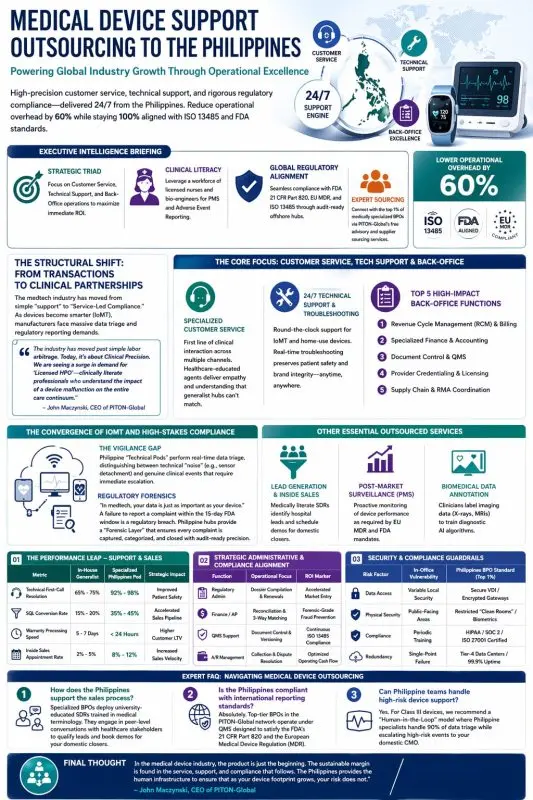
Medical device support outsourcing to the Philippines drives global scalability by integrating high-precision customer service, technical support, and rigorous regulatory compliance into a 24/7 offshore engine, reducing operational overhead by 60% while maintaining absolute ISO 13485 and FDA alignment.
Executive Intelligence Briefing
- Strategic Triad: Focus your transition on the core pillars of Customer Service, Technical Support, and specialized Back-Office operations to maximize immediate ROI.
- Clinical Literacy: Leverage a workforce of licensed nurses and bio-engineers capable of managing Post-Market Surveillance (PMS) and Adverse Event Reporting.
- Global Regulatory Alignment: Maintain seamless compliance with FDA 21 CFR Part 820, EU MDR, and ISO 13485 standards through audit-ready offshore hubs.
- Expert Sourcing: Connect with the top 1% of medically specialized BPOs via PITON-Global’s free advisory and supplier sourcing services.
The Structural Shift: From Transactions to Clinical Partnerships
The medical device industry is undergoing a permanent transformation. The traditional “support” model is being replaced by “Service-Led Compliance.” As devices become more sophisticated and connected (IoMT), manufacturers are burdened with unprecedented data triage and regulatory reporting requirements.
Medical device support outsourcing to the Philippines has emerged as the definitive “Safety Valve.” By leveraging a university-educated workforce with a deep cultural affinity for Western healthcare standards, the Philippines provides a “Human Nervous System” for global device operations.
“The industry has moved past simple labor arbitrage. Today, it’s about Clinical Precision,” says John Maczynski, CEO of PITON-Global and a leading expert on healthcare and medtech outsourcing to the Philippines. “We are seeing a massive surge in demand for ‘Licensed HPO’—where the person handling the workflow isn’t just a data entry clerk, but a clinically literate professional who understands the impact of a device malfunction on the entire care continuum.”
The Core Focus: Customer Service, Tech Support, and Back-Office
While the Philippines supports the entire product lifecycle, the most significant impact is found in three primary domains.
Specialized Customer Service
In medtech, customer service is often the first line of clinical interaction. Philippine-based teams manage multi-channel inquiries from hospitals, clinics, and patients. Because these agents often hold healthcare degrees, they provide a level of empathy and understanding that generalist hubs cannot match.
24/7 Technical Support & Troubleshooting
As devices become wearables or home-use diagnostic tools, technical issues don’t happen on a 9-to-5 schedule. Philippine hubs provide round-the-clock technical troubleshooting, ensuring connectivity issues with IoMT devices are resolved in real-time, preserving both patient safety and brand integrity.
Top 5 High-Impact Back-Office Functions
The “hidden” engine of a medical device company is its administrative accuracy. The top 5 back-office functions successfully migrated to the Philippines include:
- Revenue Cycle Management (RCM) & Billing: Managing complex reimbursement codes and payor disputes.
- Specialized Finance & Accounting: Handling multi-national accounts payable, three-way matching, and inventory reconciliation.
- Document Control & Quality Management (QMS): Managing the versioning and audit trails required for ISO 13485 compliance.
- Provider Credentialing & Licensing: Ensuring that all sales and clinical staff maintain up-to-date certifications across different regions.
- Supply Chain & RMA Coordination: Managing the logistics of Return Merchandise Authorizations (RMAs) and warranty verification to minimize user downtime.
The Convergence of IoMT and High-Stakes Compliance
The “Internet of Medical Things” (IoMT) has created a “Data Deluge.” With billions of data points generated by connected pacemakers and insulin pumps, the challenge is no longer just collecting data—it is triaging it.
The Vigilance Gap
Domestic teams are often ill-equipped to handle the 24/7 nature of connected health data. Philippine “Technical Pods” perform real-time data triage, distinguishing between technical “noise” (e.g., sensor detachment) and genuine clinical events that require immediate escalation.
Regulatory Forensics
“In medtech, your data is just as important as your device,” Maczynski notes. “A failure to report a complaint within the 15-day FDA window is a regulatory breach. Outsourcing this to a specialized Philippine hub provides a ‘Forensic Layer’ that ensures every complaint is captured, categorized, and closed with audit-ready precision.”
Other Essential Outsourced Services
Beyond the core pillars, medical device companies are increasingly leveraging the Philippines for:
- Lead Generation & Inside Sales: Medically literate SDRs identify hospital procurement leads and schedule demos for domestic closers.
- Post-Market Surveillance (PMS): Proactive monitoring of device performance as required by EU MDR and FDA mandates.
- Biomedical Data Annotation: Clinicians labeling imaging data (X-rays, MRIs) to train diagnostic AI algorithms.
Table 1: The Performance Leap — Support & Sales
| Metric | In-House Generalist | Specialized Philippines Pod | Strategic Impact |
| Technical First-Call Resolution | 65% – 75% | 92% – 98% | Improved Patient Safety |
| SQL Conversion Rate | 15% – 20% | 35% – 45% | Accelerated Sales Pipeline |
| Warranty Processing Speed | 5 – 7 Days | < 24 Hours | Higher Customer LTV |
| Inside Sales Appointment Rate | 2% – 5% | 8% – 12% | Increased Sales Velocity |
Table 2: Strategic Administrative & Compliance Alignment
| Function | Operational Focus | ROI Marker |
| Regulatory Admin | Dossier Compilation & Renewals | Accelerated Market Entry |
| Finance/AP | Reconciliation & 3-Way Matching | Forensic-Grade Fraud Prevention |
| QMS Support | Document Control & Versioning | Continuous ISO 13485 Compliance |
| A/R Management | Collection & Dispute Resolution | Optimized Operating Cash Flow |
Table 3: Security and Compliance Guardrails
| Risk Factor | In-Office Vulnerability | Philippines BPO Standard (Top 1%) |
| Data Access | Variable Local Security | Secure VDI / Encrypted Gateways |
| Physical Security | Public-Facing Areas | Restricted “Clean Rooms” / Biometrics |
| Compliance | Periodic Training | HIPAA / SOC 2 / ISO 27001 Certified |
| Redundancy | Single-Point Failure | Tier-4 Data Centers / 99.9% Uptime |
Expert FAQ: Navigating Medical Device Outsourcing
- How does the Philippines support the sales process? Specialized BPOs deploy university-educated SDRs trained in medical terminology. They engage in peer-level conversations with healthcare stakeholders to qualify leads and book demos for your domestic closers.
- Is the Philippines compliant with international reporting standards? Absolutely. Top-tier BPOs in the PITON-Global network operate under Quality Management Systems (QMS) designed to satisfy the FDA’s 21 CFR Part 820 and the European Medical Device Regulation (MDR).
- Can Philippine teams handle high-risk device support? Yes. For Class III devices, we recommend a “Human-in-the-Loop” model where Philippine specialists handle 90% of data triage while escalating high-risk events to your domestic CMO.
Final Thought “In the medical device industry, the product is just the beginning. The sustainable margin is found in the service, support, and compliance that follows,” concludes Maczynski. “The Philippines provides the human infrastructure to ensure that as your device footprint grows, your risk does not.”