
Setting a new standard for carotid artery stenting in high-risk patients.
Stroke remains one of the leading causes of death and long-term disability worldwide, with carotid artery disease causing about 10% of strokes.1 Revascularization options have traditionally included carotid endarterectomy (CEA), carotid artery stenting (CAS), and transcarotid artery revascularization (TCAR). Each has distinct advantages and procedural challenges, but recent advances in stent and embolic-protection technology are reshaping the carotid intervention landscape.
Against this backdrop, Terumo Interventional Systems (TIS), a division of Terumo Corporation, launched its FDA-approved ROADSAVER™ Carotid Stent System, indicated for use with the Nanoparasol® Embolic Protection System.
Dual-Layer Micromesh Design: the Next Generation of Carotid Stenting Technology
Introducing the ROADSAVER™ Carotid Stent System: A Revolution in Carotid Artery Treatment
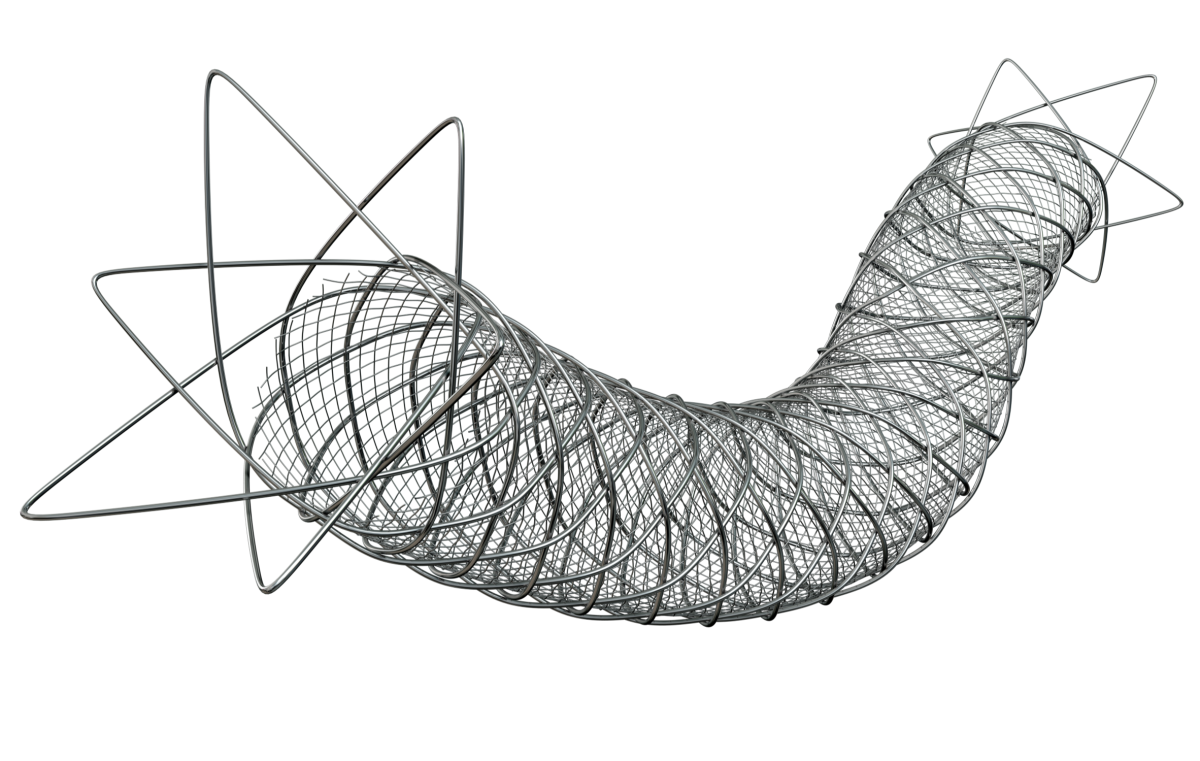
The ROADSAVER Stent System is a next-generation design featuring an innovative, dual-layer nitinol micromesh construction. The outer self-expanding nitinol scaffold provides strength and flexibility, while the inner micromesh layer serves as a continuous embolic barrier – helping to contain plaque against the vessel wall and minimize distal embolization during and after the procedure.
This dual-layer micromesh design represents the next generation of carotid stenting technology. Unlike traditional open- or closed-cell stents, which must balance flexibility against coverage, the ROADSAVER Stent System uniquely combines both: a closed-cell structure for optimal plaque coverage and the flexibility of an open-cell stent for superior wall apposition in tortuous anatomy.
The result is enhanced procedural control and protection for patients.
Designed for Precision and Efficiency
Engineering details of the ROADSAVER Stent System support both performance and operator confidence:
- Dual-layer micromesh: Designed to have the smallest, in-class stent cell size for sustained embolic protection.
- Low-profile design: 5Fr delivery system enhances crossability through challenging anatomies.
- Full resheath-ability and reposition-ability: The stent can be resheathed up to 50% deployment, allowing precise placement.
- Rapid-exchange system: 143-cm shaft with sizes ranging from 5–10 mm in width and 22–47 mm in length for tailored vessel coverage.
Clinical Performance and Patient Outcomes
Clinical data supporting the FDA approval of ROADSAVER Stent System demonstrated a low rate of death, stroke, or myocardial infarction at 30 days, and a low rate of ipsilateral stroke up to one year, underscoring both the safety and efficacy of the device in real-world settings.
The ROADSAVER Stent System is designed to contain plaque debris and prevent dislodgement. The technology may translate to fewer periprocedural strokes and improved long-term patency.
Recent data from the CREST-II trial further reinforce the role of carotid stenting in contemporary stroke prevention. The study demonstrated low periprocedural stroke and death rates in properly selected patients treated with carotid artery stenting, along with successful long-term outcomes comparable to carotid endarterectomy when performed by experienced operators. These findings support the continued evolution and adoption of modern stent technologies – such as dual-layer micromesh designs – in achieving safe and effective revascularization. 2
Comparing the ROADSAVER Stent System to Competing Technologies
Although other carotid stents are available in the US, none combine deliverability and a dual-layer micromesh design with the embolic-protection features of the ROADSAVER Stent System.
Traditional single-layer stents, such as open-cell or closed-cell nitinol scaffolds, have long procedural histories but inherent limitations:
- Open-cell designs offer flexibility but can permit plaque prolapse between struts, increasing embolic risk.
- Closed-cell designs provide better coverage but may compromise conformability in tortuous or tapered anatomy, potentially leading to malapposition.
By integrating the benefits of both open- and closed-cell designs – while minimizing their drawbacks – the ROADSAVER Stent System sets a new benchmark for procedural safety, precision, and long-term outcomes in carotid revascularization.
Looking Ahead
The limited market release of the ROADSAVER Stent System yielded its 100th successful case in October 2025. More than 1,000 procedures have been performed since the full, US-market release in February 2026. Early adoption is expected among interventional cardiologists, vascular surgeons, and neurointerventionalists seeking next-generation solutions for high-risk carotid artery disease.
As innovation continues to drive advances in endovascular therapy, Terumo’s ROADSAVER Stent System platform underscores the company’s commitment to improving both procedural performance and patient outcomes in carotid intervention.
- Mayo Clinic, Carotid artery disease, Carotid artery disease – Symptoms and causes – Mayo Clinic
- Brott TG, Howard G, Lal BK, Voeks JH, Turan TN, Roubin GS, Lazar RM, Brown RD Jr, Huston J 3rd, Edwards LJ, Jones M, Clark WM, Chamorro Á, Llull L, Mena-Hurtado C, Heck D, Marshall RS, Howard VJ, Moore WS, Barrett KM, Demaerschalk BM, Sangha N, Aronow H, Foster M, Sternbergh WC 3rd, Shawl F, Lanzino G, Rapp J, Tran HS, Ecker R, Mackey A, Ali V, Given C 2nd, Teal P, Kashyap VS, Mukherjee D, Harrigan M, Silverman S, Koopmann M, Wadley VG, Zhang Y, Rhodes JD, Chaturvedi S, Meschia JF; CREST-2 Investigators. Medical Management and Revascularization for Asymptomatic Carotid Stenosis. N Engl J Med. 2025 Nov 21. doi: 10.1056/NEJMoa2508800. Epub ahead of print. PMID: 41269206.
Disclaimers
ROADSAVER
INDICATIONS FOR USE The Roadsaver Carotid Stent System, when used in conjunction with the Nanoparasol Embolic Protection System (EPS), is indicated for the treatment of carotid artery stenosis in patients with elevated risk for adverse events following carotid endarterectomy and meet the criteria outlined below: 1. Patients who have either de novo atherosclerotic or post endarterectomy restenotic lesion(s) in the internal carotid arteries or at the carotid bifurcation with ≥50% stenosis if symptomatic or ≥80% stenosis if asymptomatic (both defined by angiography), AND 2. Patients having a vessel with reference diameters between 3.5 mm and 9.0 mm at the target lesion.
CONTRAINDICATIONS The Roadsaver Carotid Stent System is contraindicated for use in: • Patients in whom anticoagulant, antiplatelet therapy or thrombolytic drugs are contraindicated• Patients with known hypersensitivity to nickel-titanium• Patients with severe vascular tortuosity or anatomy that would preclude the safe introduction of a guide catheter, sheath, embolic protection system, or stent system• Patients with uncorrected bleeding disorders• Lesions in the ostium of the common carotid artery• Carotid vessel with <25mm gap between the target location of the distal end of the stent and the proximal end of the distal protection device. RX ONLY. Refer to the product labels and package insert for complete contraindications, warnings, precautions, potential complications, and instructions for use. Manufacturer: MicroVention, Inc., 35 Enterprise, Aliso Viejo, CA 92656, USA Distributed by Terumo Medical Corporation, 265 Davidson Ave, Somerset, NJ 08873, USA
Nanoparasol EPS
INDICATIONS FOR USE The Nanoparasol EPS is indicated for use as a guidewire to contain and remove embolic material (thrombus/debris) while performing angioplasty and stenting procedures in carotid arteries. The diameter of the artery at the site of the filter placement should be between 3.0 and 6.5 mm.
CONTRAINDICATIONS The Nanoparasol EPS is contraindicated for use in: • Patients in whom anticoagulant, antiplatelet therapy or thrombolytic drugs is contraindicated • Patients with known hypersensitivity to nickel-titanium • Patients with severe vascular tortuosity or anatomy that would preclude the landing zone requirement or the safe introduction of a guide wire, guide catheter, introducer sheath, an embolic protection device, delivery catheter, or retrieval catheter• Patients with uncorrected bleeding disorders • Lesions in the ostium of the common carotid artery ——————————————————————–RX ONLY. Refer to the product labels and package insert for complete contraindications, warnings, precautions, potential complications, and instructions for use. Manufacturer: MicroVention, Inc., 35 Enterprise, Aliso Viejo, CA 92656, USA
Distributed by Terumo Medical Corporation, 265 Davidson Ave, Somerset, NJ 08873, USA©{year} Terumo Medical Corporation.
All brand names are trademarks or registered trademarks owned by TERUMO CORPORATION, its affiliates, or unrelated third parties.